


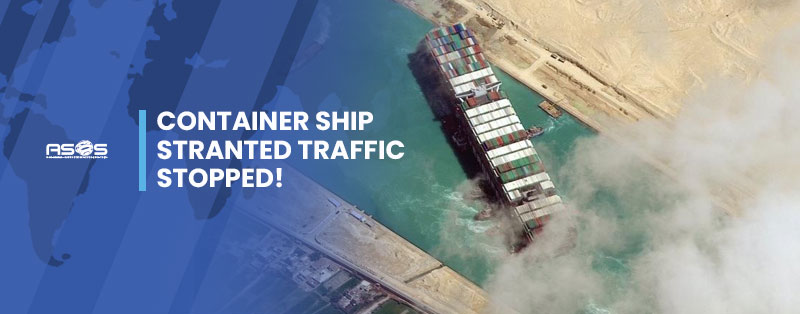
Container Ship Stranded Traffic Stopped!
Sea traffic was almost halted when the container ship Evergreen ran aground in the Suez Canal in Egypt, one of the most important canals in the world. The Suez Canal, which connects the Mediterranean sea and the Red Sea, is the main route for LNG cargoes from the Middle East to Europe and some cargoes from the Mediterranean to Asia.
The indefinite closure of the canal to sea traffic after a shipwreck in the Suez Canal, which connects the Mediterranean sea and the Red Sea, complicates liquefied natural gas (LNG) shipments to Europe.
The Suez Canal, one of the world’s busiest trade routes, has strategic importance for LNG trading, according to data compiled from Norway-based energy research firm Rystad Energy.
“Two-week shutdown could halt shipments of 2 million cubic meters of LNG”
Carlos Torres Diaz, President of Natural Gas and Electricity Markets at Rystad Energy, said in a statement that with rising temperatures in Europe, demand for natural gas is starting to decline, but continuous LNG supplies are needed to replenish low underground storage levels on the continent.
Stating that an average of 5 ships pass through the Suez Canal a week, Diaz said, “A 2-week closure may delay the delivery of approximately 2 million cubic meters of LNG to Europe. In the worst-case scenario, a 4-week shutdown would delay the delivery of approximately 4 million cubic meters of cargo.”Diaz said that even if the route is ready for crossings within a week, there will be a long line of ships to cross the channel.
For this reason, Diaz stated that it will take time for the route to return to its normal flow, “Moreover, the longer this route takes to open, the longer the ship’s queue will be.” he said.
“Russia can profit”
Recalling that Russia’s gas supply via pipeline to Europe is currently below its maximum capacity, Diaz said, “Russia’s gas supply can help provide flexibility in this process. If we look at who will benefit the most from the current situation, we can say that it is definitely Russia that is in no hurry to see the problem solved. Normally, Norway, Europe’s second largest gas supplier, could also benefit from this, but the pipeline system is now operating at almost maximum capacity,” he said.
Noting the monthly increase in U.S. gas production, Diaz said, “This increase provides an opportunity for producers in the country to secure some orders in such a shipping road crisis. Instead of traveling around Africa, which is more costly, to Reach Europe, ships will be able to ship faster to Europe from U.S. LNG export facilities,” he said.